Modifiable Risk Factors of Heart Disease
Let’s discuss “ Modifiable risk factors of Heart Disease “.
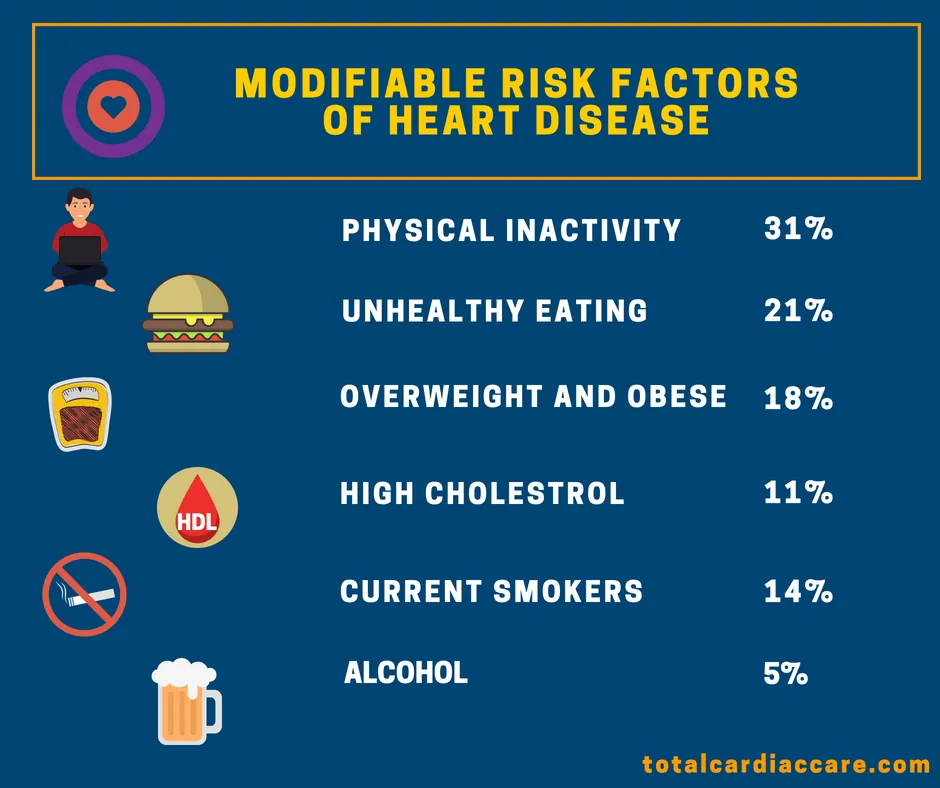 Modifiable risk factors of heart disease
A risk factor is something that increases your chance of getting a disease. The more risk factors that you have, the greater your chance of getting the disease. Risk factors are classified as Non Modifiable risk factors and Modifiable risk factors. Good news is that with modifiable risk factors, by leading a healthy lifestyle you can reduce the risk of having a heart disease greatly. Observing your heart’s well-being is a fundamental step to prevent heart diseases. Here are a few main changes that would help you reduce your risk greatly:
Modifiable risk factors of heart disease
A risk factor is something that increases your chance of getting a disease. The more risk factors that you have, the greater your chance of getting the disease. Risk factors are classified as Non Modifiable risk factors and Modifiable risk factors. Good news is that with modifiable risk factors, by leading a healthy lifestyle you can reduce the risk of having a heart disease greatly. Observing your heart’s well-being is a fundamental step to prevent heart diseases. Here are a few main changes that would help you reduce your risk greatly:
SMOKING
Smoking is the uttermost avoidable risk factor. Smokers have more than double the danger of developing a heart disease, smoking costs thirteen long years of life for a male smoker and fourteen years for a female smoker . Further, passive smoking raises the risk of having a heart disease for non-smokers.
HIGH BLOOD PRESSURE
Blood pressure is recorded as a proportion (example: 120/80 mmHg). The numerator, called systolic blood pressure, measures the weight in the arteries when the heart pulsates. The denominator, called diastolic blood pressure, measures the weight in the arteries between the heartbeats. The typical blood pressure for any individual is 130/80 mmHg, irrespective of age. High blood pressure is characterised as more than 140/90. Blood pressure ought to be measured starting at 18 years old.
DIABETES
Diabetes is defined as a fasting blood glucose (blood sugar) level of 125 mg/dL or more. There are two kinds of diabetes. Type 1 diabetes is usually first diagnosed in young adults and children. Type 2 diabetes is the most widely recognised frame and can occur at any age. There is one more type of conditional diabetes – gestational diabetes. It is a short-lived condition for women when they undergo pregnancy. Regardless of which type of diabetes you have, it implies that you have excess glucose in your blood, which can prompt genuine medical problems and also increases the risk of developing cardiovascular disease.
PHYSICAL INACTIVITY
Not getting enough physical activity and sitting too much isn’t good for your overall health, especially for your heart . There are so many ways to keep your heart healthy and young. Use smart commutes – cycle or walk to your office whenever you can. There are also many smart wearables like the Fitbit that help you keep track of your physical activity.
HIGH BLOOD CHOLESTEROL
A cholesterol profile includes LDL (bad) cholesterol, HDL (good) cholesterol, and total cholesterol.
-
Low-Density Lipoprotein Cholesterol (LDL) contributes to artery blockages. Most people should go for an LDL cholesterol level of 100 mg/dL or lower. If your risk for developing the cardiovascular disease is high, or even if you have already had a heart attack, you must aim for an LDL level of 70 mg/dL and below.
-
High-Density Lipoprotein cholesterol (HDL) helps in removing cholesterol from the arteries and takes it to the liver where it can be passed out of the body. Higher the level of HDL cholesterol lowers your risk for developing a cardiovascular disease. An HDL level of 60 mg/dL and over is considered excellent, providing you optimal protection.
-
Total cholesterol is a measure of LDL cholesterol, HDL cholesterol and, other lipids. The desirable level of total cholesterol is less than 200 mg/dL.
OBESITY
Obesity is a physical condition in which a person’s body weight is significantly above his or her ideal healthy weight. Individuals with a Body Mass Index (BMI) of 30 or higher are considered obese. Being obese can increase the risk of having a heart attack even if they have no other risk factors. Obesity can also
-
Raise blood cholesterol levels.
-
Lower your “good” HDL cholesterol level.
-
Increase blood pressure.
-
Induce diabetes.
Individuals who have an excess muscle to fat ratio, particularly around the midsection, are also prone to developing heart disease – even if they’re not obese.
Related Articles:
This page is written for general understanding and is not medical advice. It cannot take account of your own history, and a consultation is needed before any diagnosis or treatment. Written by Dr. Mahadevan R, MBBS, MS, MCh (CVTS), Chief Consultant Cardiothoracic Surgeon, Magnum Hospital, Thiruvananthapuram.